As Product Manager Biogas at Energy2market (e2m), Martin Dotzauer has been actively shaping the marketing and further development of biogas plants since 2023. He has been involved in the economic and regulatory framework conditions for bioenergy for many years.
This summer, after fourand a half years ago, he successfully completed his part-time doctorate at the University of Leipzig – with a topic that fits in perfectly with his day-to-day work. In his dissertation entitled “Evaluation of political instruments to achieve qualitative and quantitative targets for bioenergy in the German electricity sector using object-oriented programming”, he examined the effectiveness of the EEG with regard to climate protection targets, flexibilization and the expansion of biogas capacities in Germany.
His work shows: The flexible operation of biogas plants not only brings economic benefits, but also makes a measurable contribution to climate protection. At the same time, it is clear that the expansion targets in the EEG 2023 are hardly achievable under the current conditions. We spoke to Martin about his findings, the political framework conditions and his assessment of the future of the biogas sector.
From base load to flexibility
Congratulations on your successful doctorate! What was it about the topic that particularly fascinated you or motivated you to spend several years researching it?
MD: In my many years of work as a research assistant at the DBFZ at the DBFZ the EEG has always been a central point of reference. Over the years, it has set the decisive course for the further development of bioenergy from a pure base load technology to a demand-oriented and flexible option. For me, this has increasingly raised the question of whether the political toolbox fits the energy policy goals at all. As there have been hardly any reliable scientific analyses to date, this is precisely where I wanted to start with my research and create more transparency
One of your key findings is that flexible plant operation is not only economically but also ecologically beneficial. Can you briefly explain why flexibility reduces greenhouse gas emissions?
MD: Yes, that was actually one of the first questions I asked in my work. When biogas plants switch from base load operation to flexible operation, they change the order in which conventional power plants are used via the merit order principle. Even if the bioenergy plants do not generate more electricity as a result, but simply feed it in at other times, the bottom line is that emissions are saved – flexibility therefore also has a positive effect on climate policy. The effect arises from the fact that, on average, higher emissions from conventional power plants also occur during periods of high electricity prices. By feeding biogas plants into the grid at these times, they displace emission-intensive generation in favor of more climate-friendly power plants.
What do you think the ideal biogas plant looks like?
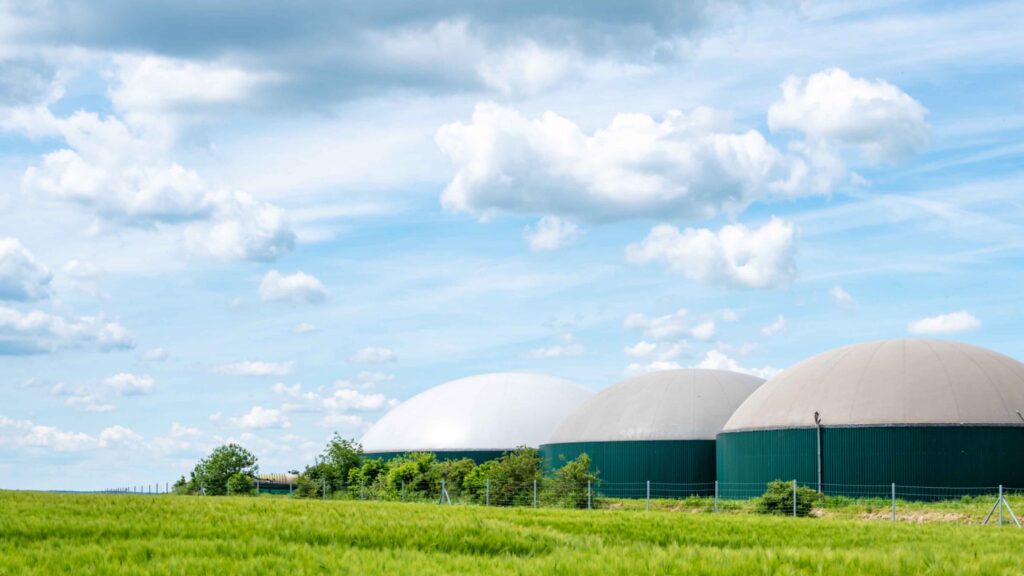
MD: The ideal system is one that is technically equipped so that it can react flexibly to the electricity market. Above all, this includes a sufficiently large gas storage facility so that the combined heat and power plant can run when electricity prices are high – and just as importantly, it can also pause when prices are low or negative. A heat storage tank is also worthwhile for heat-led systems, as it enables heat and electricity production to be decoupled.
My calculations have shown that the economically optimal range – i.e. the “sweet spot” – is a four- to six-fold overbuilding. One new 500 kWplant with 500 kW rated power achieved therefore the best cost-benefit ratio if it is is technically an installed capacity of two to three megawatts is designedhas. In principle, this also applies to existing systems, even if the depreciation periods are slightly different there due to the shorter remuneration periods.
EEG 2023 – good idea, but with design flaws
You have worked intensively on the tender design in the EEG 2023. What are your key findings?
MD: The EEG 2023 basically provides the right incentives by focusing the biogas sector more strongly on flexibility. But in detail, the design is not such that the target of 8.4 GW of installed capacity by 2030 can be achieved. The tendering volume is simply too low. A previously inflexible plant needs significantly more volume in the tendering process in order to meet the flexibility requirements. A 500 kW plant that is overbuilt to 1 MW requires twice as much tendering capacity, even though it does not produce more electricity on average. Added to this is the shortened remuneration period for existing plants – only ten years instead of twenty – which halves the long-term contribution to the expansion target. The EEG is overall but very complexcomplex and thus makes it difficult for operators to make good decisions andand also makes it difficult for It is almost impossible for politicians to assess the long-term consequences of the many regulations. My work can make a contribution here foreseeable consequences.
“We need a tender design that offers real investment security and rewards flexibility.”
You are currently working on updating the model for the new conditions of the biomass package. What will change as a result?
MD: The biomass package brings some improvements with itespecially for existing plants – such as more flexible tendering conditions, a higher flexibility surcharge and an extension of the second funding period to twelve years. I am currently investigating on behalf of the DBFZ how this will affect the development of the portfolio. Initial analyses show that although the measures are helping, the structural problems – the limited tendering volume and the short funding periods – remain. I will present reliable results by the end of the year .
Prospects for operators and the industry
Where do you currently see the biggest obstacles to greater flexibility?
MD: The biggest obstacle is economic uncertainty. Many operators know that flexibilization is technically worthwhile, but shy away from the high investments because the political and economic framework conditions cannot be planned in the long term. In addition, flexible operation requires a good marketing strategy and digital tools to optimally control the system.
What role can biogas plants play in the future in combination with wind and PV?
MD: Biogas plants are predestined to supplement the production profiles of wind and PV. They can supply electricity when there is a lack of sun and wind – and thus close supply gaps. This is often referred to as “storage power plants”. The future clearly belongs to flexible biogas plants, as base load generation will be needed less and less when there is an abundance of wind or sun. In principle, biogas can do the same as new gas-fired power plants – only decentralized, with domestic resources and thus also saferindependent of imports.
“The future clearly belongs to flexible biogas plants – they are the green gap-fillers in the energy system.”
What advice would you give to operators who want to future-proof their system?
MD: There is no way around flexibility. The question is not whether to flexibilize, but how large gas storage facilities and CHP units should be designed. It’s important to think long-term – investing in storage technology today gives you room to maneuver for the next ten years. It is just as important to regularly adapt the mode of operation to the electricity market and to recognize opportunities at an early stage in exchange with other players.
And if you had one wish for politics or the industry – what would have to change?
MD: I would like to see long-term and reliable framework conditions. Biogas is a central component of the energy transition, but this must also be reflected in the political agenda. Instead of only new, centrally controlled gas-fired power plants, we should also upgrade existing biogas plants and utilize their contribution to security of supply. To do this, we need tenders that create investment security and reward flexible output appropriately.
Conclusion
With his doctorate, Martin Dotzauer provides valuable impetus for the further development of the political framework conditions in the biogas sector. His analyses show that flexibility makes sense both economically and in terms of climate policy – and that the existing potential can only be fully exploited if politicians and the industry take long-term action with a clear perspective.