

On November 21, Martin Dotzauer, Product Manager Biogas at e2m and independent consultant, once again presented the results of the study “The Value of Flexible Bioenergy” published in Aprilas part of a workshop at the Bioenergy Status Conference, this time supplemented by initial updated estimates for the year 2024.
The study, written by Martin Dotzauer and Prof. Dr. Daniela Thrän, analyses the economic contribution of flexible bioenergy to stabilizing the electricity markets in Germany, Austria and Finland. The approach is empirical and based on historical price and generation data one calendar year. This data alone clearly shows that flexible bioenergy is a key factor for economic efficiency, stability and security of supply in European energy systems.
Bioenergy differs fundamentally from wind and solar energy:
It is renewable, but at the same time controllable. This means that it can step in as required when other renewable sources are not sufficiently available, and it is precisely at these times that its value is particularly high.
Many European countries have developed mechanisms to specifically promote flexible bioenergy:
The study shows that it is precisely this ability to drive in line with demand that generates considerable economic benefits.
The authors modeled two scenarios:
They then calculated how electricity prices would develop in both scenarios. The result is clear:
Flexible bioenergy reduces electricity procurement costs across Europe by over 1 billion euros in 2023.
The savings in detail:
Particularly noteworthy:
Although Germany has the largest bioenergy capacity of the three countries, Finland achieves the strongest relative price relief effect. This is due to the highly seasonal but system-friendly operation of Finnish biomass plants and the changing structure of the Finnish electricity market.
The authors explain this effect using the merit order principle. This regulates which power plants are used in which order:
This flexibility leads to price smoothing, a reduction in extreme price peaks and more stable overall system dynamics.
Bioenergy is thus taking on a role that will become even more important in the future alongside storage and demand side management.
The study uses an empirical ex-post model based on historical data and does not make any future forecasts.
Particularly exciting:
This lends the study a high degree of credibility because it depicts historical market reality rather than theoretical scenarios.
In his presentation, Martin Dotzauer presented the first updated estimates for the year 2024 and here too in the electricity market a clear picture:
The key message:
In 2024, too, there are clear system benefits and flexible bioenergy has generated estimated savings of €250 million in electricity procurement.
The presentation at the status conference made it clear:
Bioenergy is at a crucial threshold – not only as a renewable energy source, but as a system-stabilizing force whose potential can be leveraged even more politically and economically.
The study and the supplemented 2024 assessments show unmistakably:
Flexible bioenergy works – and to an extent that has often been underestimated. It lowers electricity prices, strengthens security of supply, stabilizes renewable electricity systems and is becoming an indispensable component of the energy transition.
As the share of wind and solar increases, its value will continue to rise and it will play a key role in the European energy system of the future.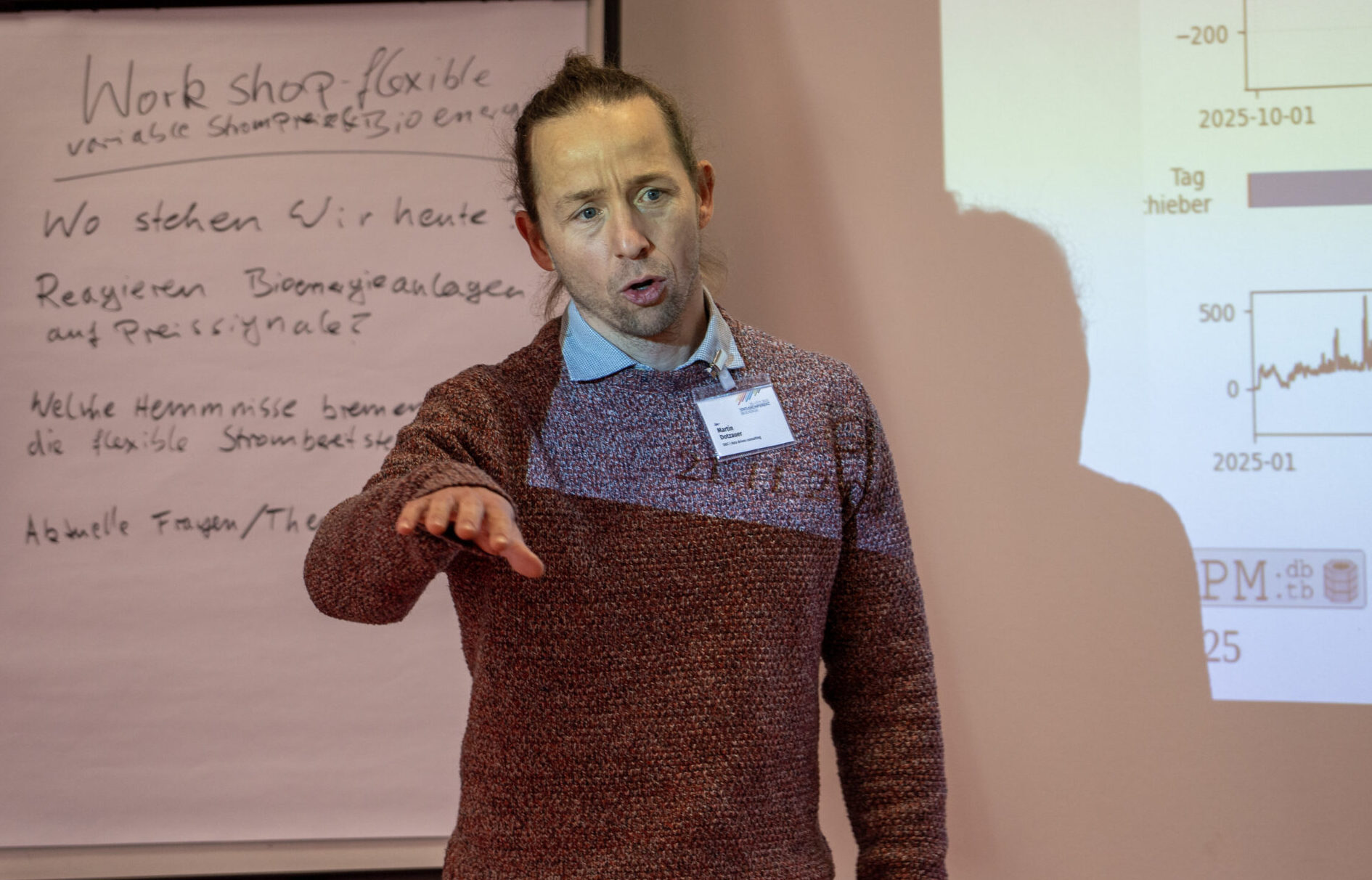
📄 To the study (PDF):
The Value of Flexible Bioenergy – IEA Bioenergy Task 44


You are currently viewing a placeholder content from Vimeo. To access the actual content, click the button below. Please note that doing so will share data with third-party providers.
More InformationYou are currently viewing a placeholder content from YouTube. To access the actual content, click the button below. Please note that doing so will share data with third-party providers.
More InformationYou need to load content from reCAPTCHA to submit the form. Please note that doing so will share data with third-party providers.
More InformationYou need to load content from hCaptcha - Formidable to submit the form. Please note that doing so will share data with third-party providers.
More InformationYou need to load content from reCAPTCHA to submit the form. Please note that doing so will share data with third-party providers.
More InformationYou need to load content from Turnstile to submit the form. Please note that doing so will share data with third-party providers.
More InformationYou are currently viewing a placeholder content from Google Maps. To access the actual content, click the button below. Please note that doing so will share data with third-party providers.
More InformationYou are currently viewing a placeholder content from Mapbox. To access the actual content, click the button below. Please note that doing so will share data with third-party providers.
More InformationYou are currently viewing a placeholder content from OpenStreetMap. To access the actual content, click the button below. Please note that doing so will share data with third-party providers.
More Information