
Speira aluminum rolling mill
Home / Case studies /
Cost Reduction and Sustainability for Industrial Companies Using Battery Storage Systems
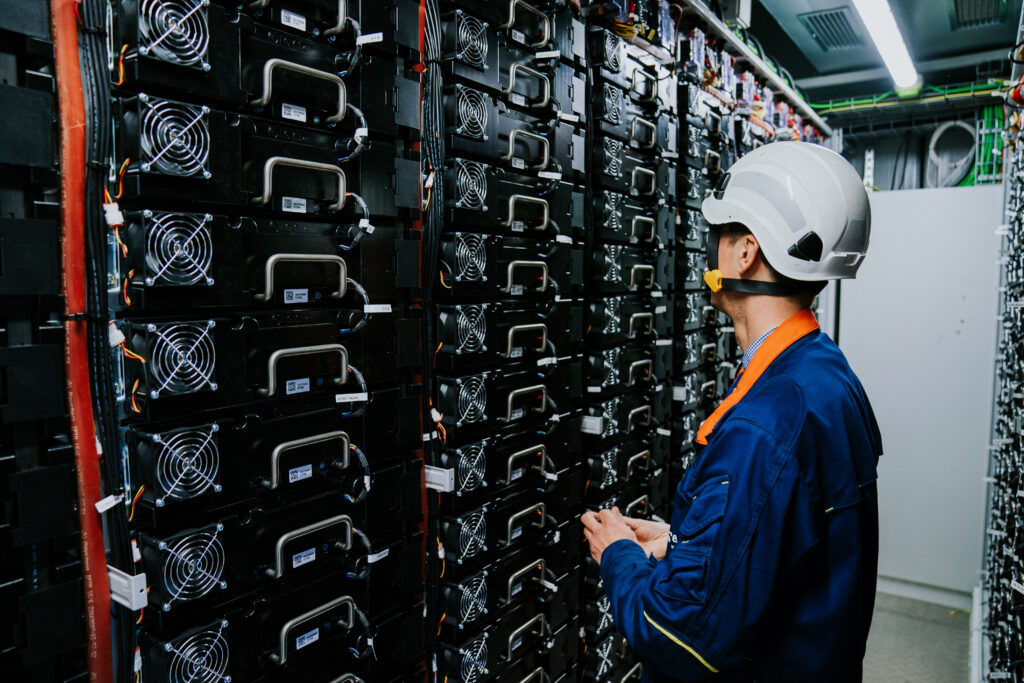
Since November 2021, e2m, together with its sister company EDF Renewables, has been operating a smart battery storage system as a full-service provider at the Hamburg plant of Speira, an aluminum rolling and recycling company. The results have been consistently positive: Since then, 272 battery modules have been reliably delivering 1.6 MW of power for one hour—enough to support the transmission system operator in stabilizing the power grid through smart load management, without affecting the company’s production processes. As planned, the battery storage has enabled Speira to benefit from atypical grid usage by reducing load peaks during the transmission system operator’s high-load time windows (peak shaving) and thereby lowering the company’s energy costs.
In this three-party arrangement, E2m is responsible for marketing flexibility on the balancing energy markets and has secured technical and regulatory access to the balancing energy market—in this case, to Frequency Containment Reserve.
Short and sweet
Technical details
- Potential annual savings: over 100,000 euros
- Connection to the high-voltage grid
- 20-foot container
- 272 modules, 16 racks
- Lithium-Nickel-Manganese-Cobalt Oxides (NMC)
- 1.6 MWh capacity
- 1.6 MW of power
Services from e2m
- Balancing Energy Trading
"e2m's marketing solutions perfectly complement our approach. Within the EDF cluster, we can work together to maximize the revenue potential of the battery storage system while conserving resources."
Clotaire François, Managing Director, EDF Renewables Storage Deutschland GmbH

Interview with Clotaire François, Managing Director of EDF Renewables Storage Deutschland GmbH
Did Speira already have specific ideas about the storage system, or did you provide advice on the design?
Industrial companies today face tough challenges due to the energy crisis. They are confronted with intensified competition, and their energy costs are skyrocketing. Speira had therefore already taken initial steps toward developing a load management system designed to help reduce costly peak loads. However, companies are often not 100% satisfied with these systems, as they frequently require adjustments to production planning. We therefore analyzed consumption patterns over the past few years, as well as the duration and frequency of peak loads, and ultimately calculated the optimal storage capacity.
We always offer our customers a complete battery storage design service. In addition, we handle everything related to installation, operation, and financing. Our goal is to provide our customers with a comprehensive, worry-free package. This also means that the company itself does not have to make any investment or deal with the operation of the battery storage. All of that falls within our scope of responsibility: We ensure that the battery storage reduces peak loads and, consequently, electricity costs—we share the savings—as is the case with Speira.
What, specifically, did Speira have to take into account?
The challenge at Speira was to increase or decrease electricity demand within the correct time window. This is because furnaces cannot simply be shut down without disrupting the production process. This is where our battery storage system comes in: It takes over the power supply for 15, 30, 45, or 60 minutes, thereby ensuring uninterrupted operation. In doing so, it helps manage peak loads without requiring a company like Speira to change its processes.
How long did the implementation take?
It takes about a year from signing the contract to commissioning the battery storage. We need most of that time to obtain the necessary permits, such as building and grid connection permits. Depending on the workload of the authorities, this can take several months. The actual on-site work—such as pouring the foundation or connecting the storage system—takes only a few days in each case. The connection for marketing and the prequalification process with e2m are also well-established procedures that enable a quick start to marketing.
For cost-effective operation, a battery storage system usually has to perform several functions. Does peak load shaving alone make the investment worthwhile, or are there other solutions that further contribute to the ROI?
That’s right; as a rule, at least two applications must be linked together. Peak load shaving alone is not enough—it’s only part of the economic viability. Additional revenue streams can be added to this. Specifically—including with the battery storage system at the Speira plant—we work with e2m, which handles the marketing of balancing energy on our behalf. The advantage of battery storage systems is that they can store or release energy within seconds and thus provide extremely rapid support to the transmission grid.
e2m’s marketing solutions perfectly complement our approach. Within the EDF cluster, we can work together to maximize the revenue potential of the battery storage system while conserving resources.
How should peak load reduction and electricity market trading be coordinated?
Here, we benefit from the fact that the various use cases are predictable and can therefore be easily combined. For peak load shaving, we utilize a specific scenario referred to as “atypical grid usage” in the relevant regulation. In this process, we use battery storage to support stability in the distribution grid by reducing load peaks at Speira precisely during the times when the grid is already under high load (during so-called high-load time windows). These are determined by the transmission system operator. In this way, the battery storage can help reduce peak loads at Speira precisely during these times. The rest of the time, it can be used on the balancing power market to offset fluctuations in the transmission grid.
Are there also positive effects on climate protection, such as a reduction in CO2 emissions?
Absolutely: Many energy storage projects are currently getting underway—they are a key component of EDF’s global strategy for low-carbon energy generation by 2050. In addition to expanding renewable energy worldwide, another goal is to build robust infrastructure for utilizing decentralized energy and grid-supporting flexibility. All of us in the EDF cluster are contributing to this with our respective strengths. The implementation of smart battery storage in collaboration with committed commercial and industrial (C&I) customers is therefore a key step toward expanding this sustainability strategy while simultaneously working together to ensure the success of the energy transition.
Get in touch
with us

Interested in battery storage?
Our partner EDF power solution offers battery storage in a profit-share model, without any investment costs of its own.